SHIFT MODES
Three ways to shift.
Comfort, Sport or your choice of gear. In Manual, the cluster shows the selected gear.
Tap the mode buttonon the gear lever to cycle through the shift modes.
SPORT-SHIFT FIRMWARE / SMART ROADSTER 452
INDEPENDENTLY ENGINEEREDFast upshifts. Rev-matched downshifts. And a throttle that stays open through the shift to help preserve boost.
Three selectable engine maps: Stock, Sport and Stage 1.
Join the waitlistNo payment. No commitment.
01 / FLAT-FOOT SHIFTING
A gear change shouldn’t keep you waiting.
In a conventional shift, the throttle closes and boost drops. The next gear arrives, but the engine has to build that pressure again.
AFTERSHIFT 452 keeps the throttle open through the upshift. Fuel cut and ignition retard manage engine torque instead, helping preserve boost so the car gets back on power more eagerly.
That’s flat-foot shifting. Keep your foot in; the software handles the shift.
Not just another calibration. New upshift controllers, rewritten downshift control and automatic rev-matching change how the clutch, selector and engine work together.
STOCK VS AFTERSHIFT 452
02 / AUTOMATIC REV-MATCHING
Race-inspired response.
Developed to avoid unnecessary harshness.
When auto-blip is active, it raises the engine towards the revs needed for the lower gear. You concentrate on your line. The software handles the rev-matching.
Matching the revs means the clutch has less speed difference to absorb when it reconnects the engine to the gearbox. It can engage sooner and more decisively, with less time spent slipping to bring the engine up to speed.
That’s what makes rev-matching central to fast downshifts: it lets the shift-control software make full use of the hardware’s speed, instead of holding back to smooth out an RPM mismatch.
03 / MORE WAYS TO DRIVE
SHIFT MODES
Comfort, Sport or your choice of gear. In Manual, the cluster shows the selected gear.
Tap the mode buttonon the gear lever to cycle through the shift modes.
ENGINE MAPS
Choose your engine map from the driving seat, using the same gear lever button.
Hold for 3 seconds in Neutralto change the engine map.
IGNITION ON
A signature gauge sweep and an A · S · 4 · 5 · 2 greeting in the instrument cluster.
Switch the ignition onand let your Roadster say hello.
04 / OUR STORY
About two years ago, we rediscovered the Smart Roadster. Before long, we had several between us.
We're a group of computer science enthusiasts, drivers and collectors. The Roadster immediately won us over: light, playful and full of character, with handling that makes you look forward to the next bend.
But we couldn't bear the gearbox.
On a winding road, its short gearing should be part of the enjoyment. Instead, we could ask for a lower gear and spend seconds waiting for the power to return. The car was ready for the corner. The shift wasn't ready for the exit.
We found ourselves driving around the gearbox, holding a gear rather than changing down when we wanted to. It took the playfulness out of a car that had so much of it elsewhere.
That frustration became the starting point for AFTERSHIFT 452.
Our first changes were to the original calibration. They improved the shifts considerably and showed how much potential remained in the existing hardware.
Downshifts still felt sluggish. To go further, we needed to understand the decisions behind them: when the ECU reduced engine power, moved the selector, re-engaged the clutch and handed the throttle back to the driver.
Each action had to work with the others. Changing individual values could only take us so far. The next step was to investigate and redesign the control sequence itself.
Modern firmware analysis helped us work through the original software, instruction by instruction. We then developed an ECU emulator and a software bench to execute the control code offline and run thousands of software test cases.
We could vary inputs, examine transitions and interrupt sequences, following the decisions the software actually made. That visibility took us beyond calibration: rewritten downshift control, automatic rev-matching and new upshift controllers. Flat-foot shifting now changes how the engine manages torque during the shift, too.
Then we needed to see what happened in the cars.
We extended telemetry over the ECU's existing CAN bus to obtain internal signals from our development vehicles in real time. Engine revs, shift phases, throttle commands and clutch movement could be examined together.
The recordings gave us a way to revisit a shift, follow it through the data and compare its behaviour across gears, engine speeds and pedal inputs. We could connect what we felt behind the wheel with what the controller was doing, then use that understanding to guide the next change.
FROM OUR DEVELOPMENT VEHICLES
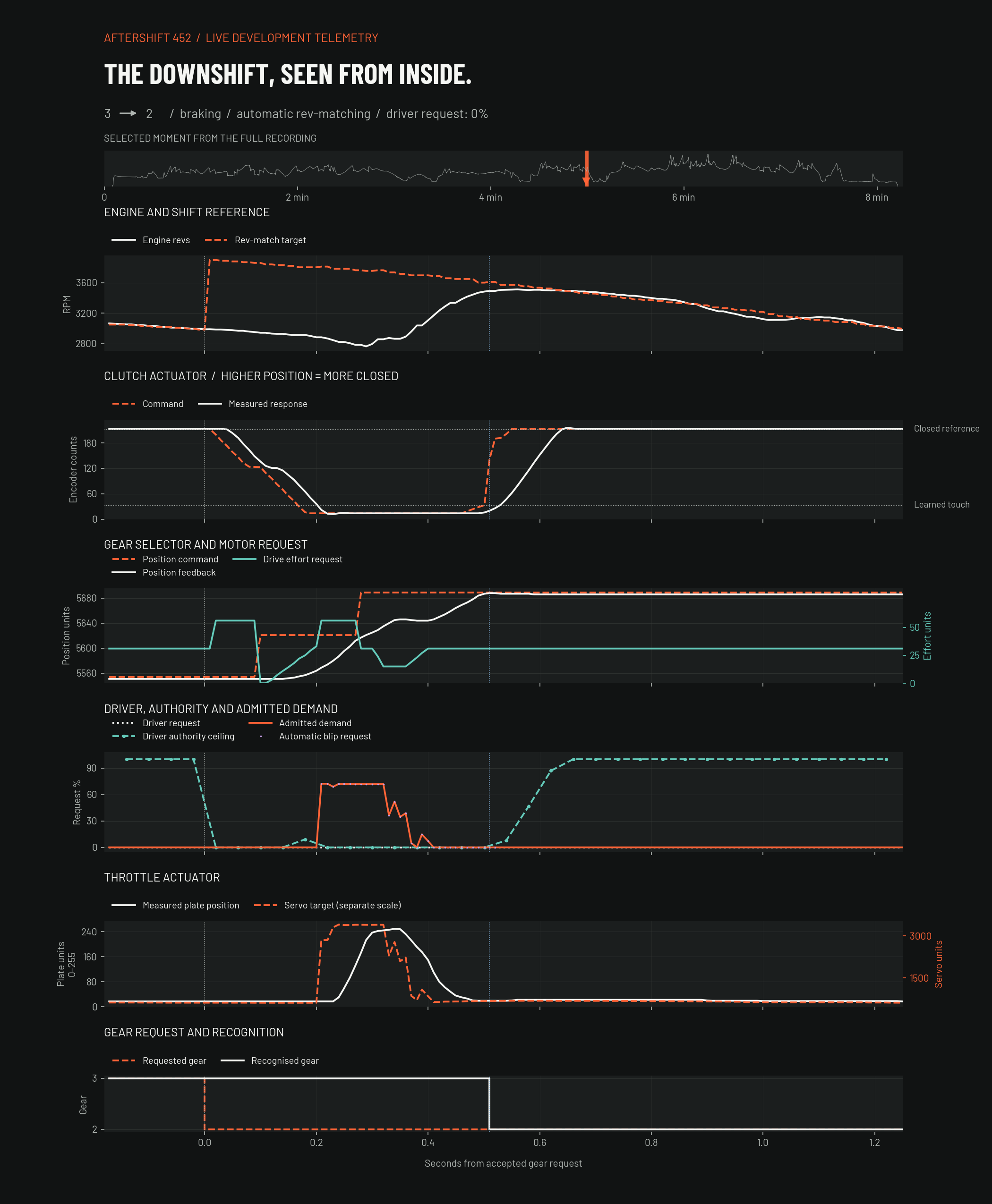
A braking downshift: automatic throttle input raises engine revs while the selector moves, followed by clutch re-engagement.
View full trace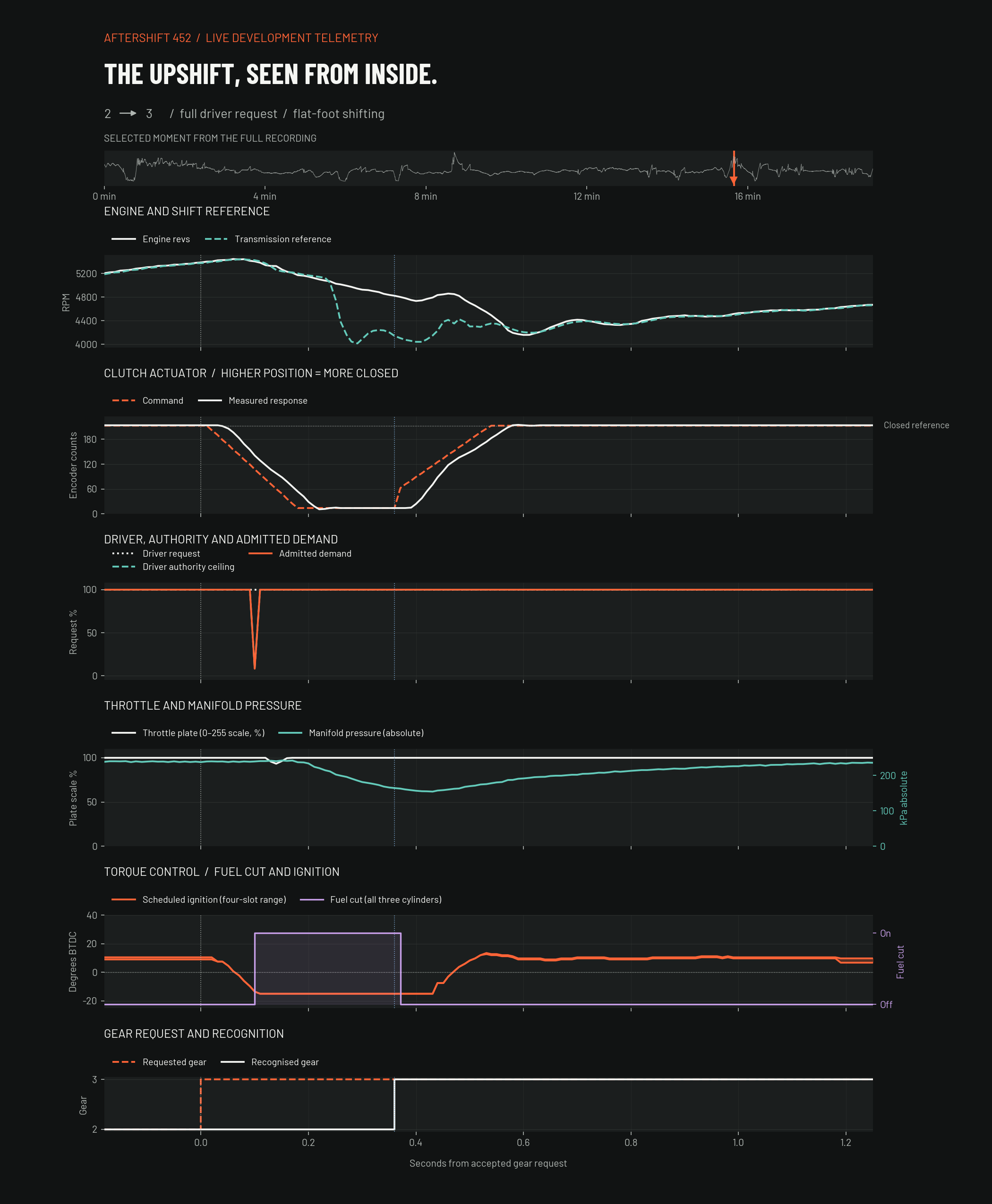
A full-throttle 2-to-3 upshift: the throttle stays open while fuel cut and ignition timing manage torque. Follow the clutch command and response alongside manifold pressure and the return of power.
View full traceWe refined the software through offline testing, telemetry analysis and real-world testing on our development vehicles. The throttle blip, clutch engagement and return of power were developed together, with the driving experience guiding the work.
Automatic rev-matching brings the engine towards the speed the lower gear needs, reducing the difference the clutch has to absorb. Redesigned downshift control coordinates that with gear selection, engagement and the return of power.
The aim is the feeling that started the project: a Roadster whose gearbox is part of the enjoyment.
Choose the lower gear because the next corner calls for it. Feel the engine meet the shift. Get back on the power and enjoy the car's playfulness again.
BEFORE YOU COMMIT
Yes. AFTERSHIFT 452 combines new upshift controllers, rewritten downshift control, automatic rev-matching and flat-foot shifting. It changes the shift strategy itself, not just the calibration values. The rest of the factory engine and gearbox software is retained where needed.
Compatibility will be checked individually before installation. No vehicle details are needed to join the waitlist.
Custom rev-matching comes into play during sporty driving. At low revs and during calm downshifts, the car retains its stock, comfort-oriented behaviour, with a gentler, more gradual shift. Sharper when you’re pressing on, relaxed when you’re taking it easy.
No. Software cannot repair clutch wear, actuator faults or an incorrect mechanical setup. Slipping, warnings or existing shifting faults should be assessed before a performance modification. Engagement feel and component wear depend on the vehicle and its use.
Yes. Choose Distributor in the form and tell us about your business.
Yes. AFTERSHIFT 452 includes three selectable engine maps: Stock (M1), Sport (M2) and Stage 1 (M3). A competent tuner can further adjust the engine parameters in the supplied image, provided they understand this firmware and know what they are doing. They must preserve the shift-control and licensing code and correctly update the required checksums.
Each issued image is individually generated and contains customer-specific forensic identifiers to help trace unauthorised redistribution. A licence for one vehicle is not permission to copy, resell or install it on another.
That depends on your country, vehicle and the modification. No road-use approval is claimed. Check applicable vehicle, emissions, noise and insurance requirements with a qualified local professional before installation. Calling a product “motorsport” does not itself establish a legal exemption.